How Residential Property Clearance in Vienna Supports Farming and the Environment?
Residential property clearance in Vienna (objekträumung Wien) is evolving into more than a simple waste removal service. As cities place greater emphasis on sustainability and environmental responsibility, property clearance operations are becoming closely tied to recycling systems, circular economies, and agricultural resource management. When apartments, homes, or inherited estates are emptied, the process generates large volumes of materials that can either become landfill waste or valuable reusable resources.
Modern clearance companies increasingly focus on reducing environmental impact by separating recyclable items, recovering reusable materials, and directing organic waste toward composting systems that support farming and soil health. In this way, residential property clearance contributes not only to cleaner urban spaces but also to broader environmental and agricultural goals.
Environmental Challenge of Residential Property Clearance
Clearing a residential property often involves removing a wide variety of materials accumulated over many years, which may include but not limited to:
- Furniture
- Wood and construction debris
- Textiles and clothing
- Electronics
- Kitchen appliances
- Paper products
- Organic household waste
Without organized recycling systems, many of these materials would simply end up in landfills. This creates environmental problems such as increased waste accumulation, higher carbon emissions, and unnecessary consumption of raw resources.
In cities like Vienna, however, modern property clearance services are increasingly integrated into structured waste sorting and recovery systems. Instead of treating every item as disposable, clearance providers now evaluate which materials can be:
- Recycled
- Repaired
- Repurposed
- Donated
- Composted
This shift reflects the growing influence of circular economy principles, where materials remain in use for as long as possible rather than being discarded after a single life cycle.
Recycling and Material Recovery in Urban Environments
One of the most important aspects of environmentally conscious property clearance is material recovery. Many items removed from residential properties still contain reusable value even if they are no longer wanted by the owner.
Wood from furniture can sometimes be repurposed into recycled building materials or processed into biomass products. Metals from appliances and fixtures can be separated and melted down for reuse in manufacturing. Textiles may be redirected to recycling facilities or charitable organizations.
Electronics represent another major category. Proper e-waste recycling helps recover valuable components such as copper, aluminum, and rare metals while preventing hazardous substances from entering the environment. Professional property clearance services often work closely with:
- Recycling centers
- Donation networks
- Waste processing facilities
- Municipal sustainability programs
This coordination reduces landfill dependency while supporting resource efficiency across multiple industries.
Organic Waste and Agricultural Benefits
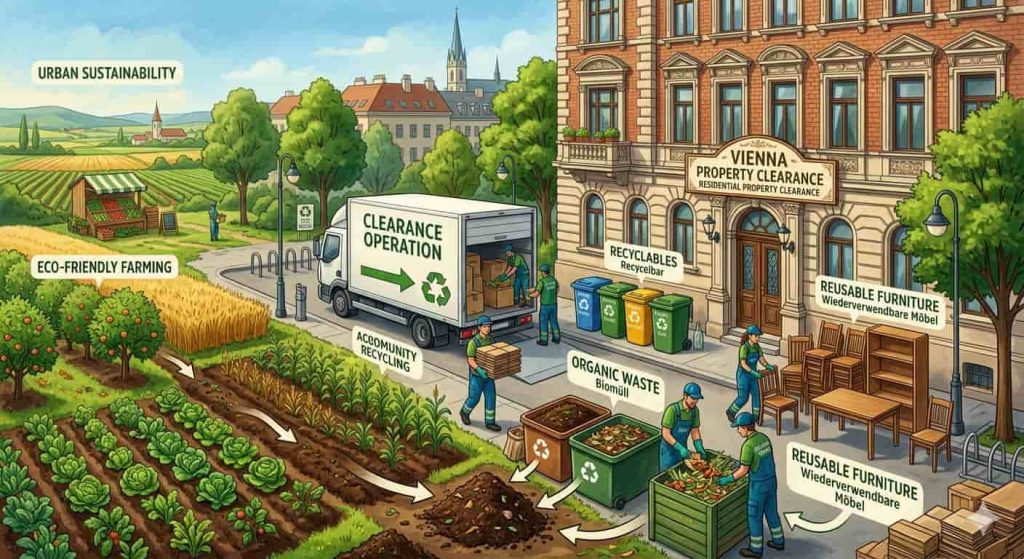
One of the strongest connections between residential clearance and farming lies in the management of organic and biodegradable waste, which is the reason why during property clearance, organic materials such as food remnants, plant waste, natural fibers, untreated wood, and paper products can often be separated for composting programs instead of disposal.
Composting transforms organic waste into nutrient-rich material that can improve soil quality, water retention, and agricultural productivity.
Instead of viewing biodegradable material as garbage, sustainable clearance systems recognize its value within agricultural and environmental cycles.
By diverting organic waste away from landfills, cities also reduce methane emissions produced through decomposition in traditional waste disposal environments.
Circular Economy Principles in Property Clearance
The growing emphasis on circular economy models is reshaping how residential clearance services operate. A circular economy aims to minimize waste by extending the lifespan of products and materials through reuse, recycling, and recovery. Property clearance services increasingly support this model by prioritizing:
- Reuse before disposal
- Material recovery before landfill use
- Repair and refurbishment opportunities
- Donation systems for usable items
For example, furniture removed during a property clearance may still be suitable for secondhand markets or charitable organizations. Appliances can sometimes be repaired and redistributed rather than destroyed.
This approach benefits both the environment and local communities by reducing unnecessary consumption while helping usable goods remain productive.
Urban Sustainability and the Future of Clearance Services
As sustainability goals continue expanding across Europe, property clearance services are likely to become even more integrated into smart urban environmental systems. Future developments may include:
- AI-assisted waste sorting
- Digital material tracking systems
- Advanced recycling analytics
- Carbon-efficient transport planning
- Automated resource recovery systems
These innovations could help cities process clearance waste more efficiently while maximizing recycling and recovery rates.
Public awareness also plays a growing role. Homeowners and property managers increasingly prefer environmentally responsible clearance providers that demonstrate strong recycling practices and sustainable disposal methods.
In cities like Vienna, where sustainability already plays a major role in urban planning, residential clearance services are becoming an important part of broader environmental infrastructure.
Enhanced Property Clearance Techniques and Management
Residential property clearance in Vienna is evolving into a sustainability-focused service that supports both environmental protection and agricultural resource management. Through recycling systems, composting initiatives, material recovery programs, and circular economy practices, clearance operations now contribute to much larger ecological goals than simple waste removal.
By redirecting reusable materials, processing organic waste responsibly, and reducing landfill dependency, modern property clearance services help transform urban waste into valuable environmental resources. This creates meaningful connections between city infrastructure, farming support systems, and sustainable development strategies.